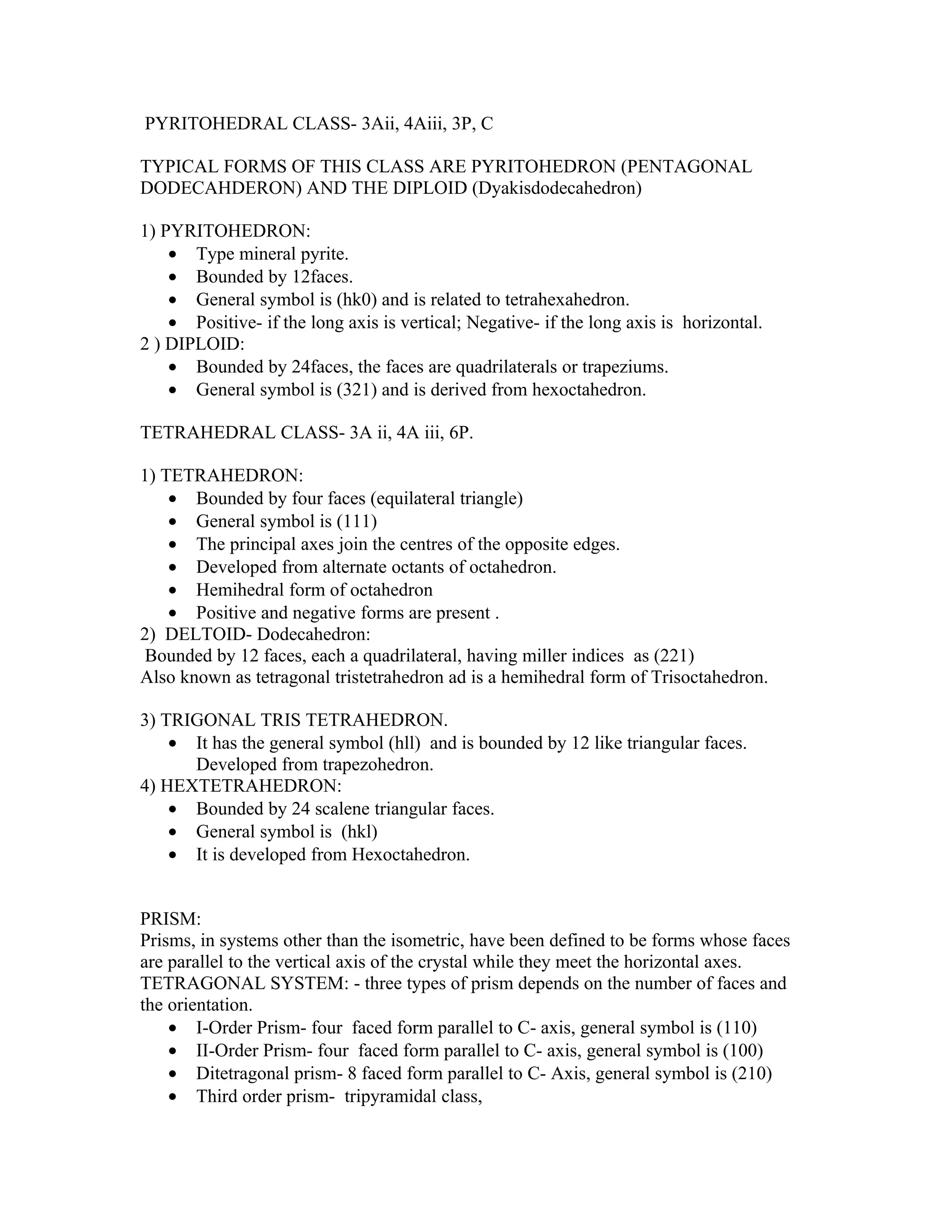
PYRITOHEDRAL CLASS- 3Aii, 4Aiii, 3P, C

TYPICAL FORMS OF THIS CLASS ARE PYRITOHEDRON (PENTAGONAL
DODECAHDERON) AND THE DIPLOID (Dyakisdodecahedron)

1) PYRITOHEDRON:
    • Type mineral pyrite.
    • Bounded by 12faces.
    • General symbol is (hk0) and is related to tetrahexahedron.
    • Positive- if the long axis is vertical; Negative- if the long axis is horizontal.
2 ) DIPLOID:
    • Bounded by 24faces, the faces are quadrilaterals or trapeziums.
    • General symbol is (321) and is derived from hexoctahedron.

TETRAHEDRAL CLASS- 3A ii, 4A iii, 6P.

1) TETRAHEDRON:
    • Bounded by four faces (equilateral triangle)
    • General symbol is (111)
    • The principal axes join the centres of the opposite edges.
    • Developed from alternate octants of octahedron.
    • Hemihedral form of octahedron
    • Positive and negative forms are present .
2) DELTOID- Dodecahedron:
 Bounded by 12 faces, each a quadrilateral, having miller indices as (221)
Also known as tetragonal tristetrahedron ad is a hemihedral form of Trisoctahedron.

3) TRIGONAL TRIS TETRAHEDRON.
    • It has the general symbol (hll) and is bounded by 12 like triangular faces.
      Developed from trapezohedron.
4) HEXTETRAHEDRON:
    • Bounded by 24 scalene triangular faces.
    • General symbol is (hkl)
    • It is developed from Hexoctahedron.


PRISM:
Prisms, in systems other than the isometric, have been defined to be forms whose faces
are parallel to the vertical axis of the crystal while they meet the horizontal axes.
TETRAGONAL SYSTEM: - three types of prism depends on the number of faces and
the orientation.
    • I-Order Prism- four faced form parallel to C- axis, general symbol is (110)
    • II-Order Prism- four faced form parallel to C- axis, general symbol is (100)
    • Ditetragonal prism- 8 faced form parallel to C- Axis, general symbol is (210)
    • Third order prism- tripyramidal class,
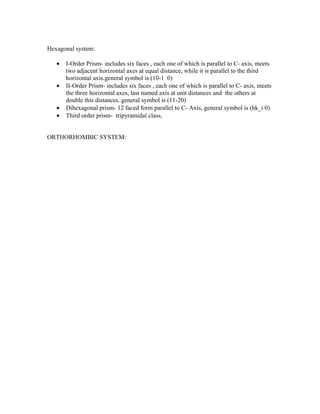
Hexagonal system:

   •   I-Order Prism- includes six faces , each one of which is parallel to C- axis, meets
       two adjacent horizontal axes at equal distance, while it is parallel to the third
       horizontal axis.general symbol is (10-1 0)
   •   II-Order Prism- includes six faces , each one of which is parallel to C- axis, meets
       the three horizontal axes, last named axis at unit distances and the others at
       double this distances..general symbol is (11-20)
   •   Dihexagonal prism- 12 faced form parallel to C- Axis, general symbol is (hk_i 0)
   •   Third order prism- tripyramidal class,


ORTHORHOMBIC SYSTEM:

Forms of crystals.

  • 1.
    PYRITOHEDRAL CLASS- 3Aii,4Aiii, 3P, C TYPICAL FORMS OF THIS CLASS ARE PYRITOHEDRON (PENTAGONAL DODECAHDERON) AND THE DIPLOID (Dyakisdodecahedron) 1) PYRITOHEDRON: • Type mineral pyrite. • Bounded by 12faces. • General symbol is (hk0) and is related to tetrahexahedron. • Positive- if the long axis is vertical; Negative- if the long axis is horizontal. 2 ) DIPLOID: • Bounded by 24faces, the faces are quadrilaterals or trapeziums. • General symbol is (321) and is derived from hexoctahedron. TETRAHEDRAL CLASS- 3A ii, 4A iii, 6P. 1) TETRAHEDRON: • Bounded by four faces (equilateral triangle) • General symbol is (111) • The principal axes join the centres of the opposite edges. • Developed from alternate octants of octahedron. • Hemihedral form of octahedron • Positive and negative forms are present . 2) DELTOID- Dodecahedron: Bounded by 12 faces, each a quadrilateral, having miller indices as (221) Also known as tetragonal tristetrahedron ad is a hemihedral form of Trisoctahedron. 3) TRIGONAL TRIS TETRAHEDRON. • It has the general symbol (hll) and is bounded by 12 like triangular faces. Developed from trapezohedron. 4) HEXTETRAHEDRON: • Bounded by 24 scalene triangular faces. • General symbol is (hkl) • It is developed from Hexoctahedron. PRISM: Prisms, in systems other than the isometric, have been defined to be forms whose faces are parallel to the vertical axis of the crystal while they meet the horizontal axes. TETRAGONAL SYSTEM: - three types of prism depends on the number of faces and the orientation. • I-Order Prism- four faced form parallel to C- axis, general symbol is (110) • II-Order Prism- four faced form parallel to C- axis, general symbol is (100) • Ditetragonal prism- 8 faced form parallel to C- Axis, general symbol is (210) • Third order prism- tripyramidal class,
  • 2.
    Hexagonal system: • I-Order Prism- includes six faces , each one of which is parallel to C- axis, meets two adjacent horizontal axes at equal distance, while it is parallel to the third horizontal axis.general symbol is (10-1 0) • II-Order Prism- includes six faces , each one of which is parallel to C- axis, meets the three horizontal axes, last named axis at unit distances and the others at double this distances..general symbol is (11-20) • Dihexagonal prism- 12 faced form parallel to C- Axis, general symbol is (hk_i 0) • Third order prism- tripyramidal class, ORTHORHOMBIC SYSTEM: